Going to school as an adult can be intimidating and a drain on time and energy. Especially when you combine that training with a full-time position and a personal life.
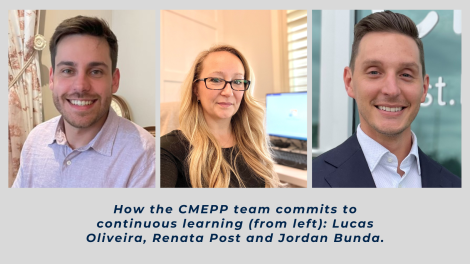
At CMEPP, we understand those pressures but support employees in their continuous learning journeys. The skills employees develop build on their talents and confidence and ultimately benefit our organization. Here are stories of three employees who are committed to their own education and professional development.
______________________________________________
Jordan Bunda, Relationship Executive, Ontario – Enrolled in the Non-Profit Leadership, Strategy & Change course at University of Toronto School of Continuing Studies
What motivated you to take this program?
This is my first role in the non‑profit sector and I wanted to deepen my understanding of non‑profit leadership and governance. I see the course as an opportunity to develop the perspective and confidence to contribute more meaningfully to strategic discussions and future leadership opportunities at CMEPP.
How are you managing to juggle course work, your full-time position, and your personal life?
It’s definitely been a busy season! I got married shortly after the course began, I’m training for a half marathon, and I just started tennis lessons. Thankfully, the program is designed with working professionals in mind. Many of the assignments directly relate to my role at CMEPP, which makes the workload feel integrated rather than additive. Staying active, time‑blocking, and setting clear priorities has helped me stay focussed and energized.
Can you talk about any specific lesson (or lessons) you’ve learned that have impacted you and that you’re already putting into practice?
One of the biggest takeaways has been a deeper appreciation for the role of governance and the board‑management relationship in non‑profit success. The course has helped me better understand where management’s role ends, where the board’s begins, and how strong alignment between the two supports effective strategy and sustainability.
I’ve also become much more intentional about thinking system‑wide – considering how decisions impact not just immediate outcomes, but people, processes, and the mission. Having a more holistic mindset has already influenced how I approach internal conversations, Participant engagement, and strategic initiatives at CMEPP.
____________________________________________________
Lucas Oliveira, Assistant Controller – Working towards his CPA designation
What do you like about the program?
The program builds strong accounting, finance, and business judgment skills. I like that it’s practical and focused on real‑world decision‑making, not just theory.
How are you juggling course work, your job and your personal life?
The courses are very dense, but having a solid study schedule helps me stay organized and keep everything manageable.
Is there a specific lesson you’re putting into practice now?
One area that’s been especially valuable is learning about accounting standards for not‑for‑profit organizations. Since CMEPP operates in this space, understanding these standards has helped me see how financial reporting, compliance, and decision‑making all connect. I now have a clearer picture of the financial side of the organization and how accounting supports its overall mission.
__________________________________________________
Renata Post, Business Analyst, Proposals and Reporting – Completed the two-year diploma program in IT Professional with a focus on Cloud Computing, Cybersecurity, and IT Project Management.
What drew you to course of study?
I’ve always had a passion for technology and wanted to expand my understanding of both the technical and business aspects of IT. The two-year diploma program in IT Professional covered a broad range of topics including networking, cloud technologies, server administration, virtualization, cybersecurity, project planning, risk management, and IT service delivery. What drew me to it was the opportunity to develop hands-on technical skills while also learning how to manage and deliver technology projects effectively.
Are there specific skills or knowledge areas that have translated directly to your professional role?
The program has been extremely valuable in my role as a Business Analyst. While my day-to-day work focuses on data, reporting, and business processes, the technical knowledge I gained in cloud computing, cybersecurity, and networking has helped me better understand the systems and infrastructure that support our organization.
The IT Project Management component has also been particularly beneficial, providing practical skills in project planning, stakeholder communication, requirements gathering, risk assessment, and change management. These skills translate directly into the projects I lead and support, helping me bridge the gap between business needs and technical solutions.
How have you achieved balance between work and studies? Can you provide any practical tips?
Balancing full-time work, studies, and family responsibilities required careful planning and strong time management skills. What worked for me was creating a structured schedule, setting realistic goals, and breaking larger assignments into manageable tasks. Staying organized and maintaining consistent study habits helped prevent last-minute stress. I also looked for opportunities to connect what I was learning in the classroom to real projects at work, which made the material more meaningful and easier to retain.
My advice to other students is to stay disciplined, start assignments early, and focus on steady progress rather than perfection. Consistency and organization go a long way when balancing multiple commitments.