After a rewarding 28-year career in sales and leadership at McKesson, Ron Dunn thought he would retire. His mighty rolodex had other ideas. He soon discovered a business niche helping technology and software companies break into the Canadian healthcare marketplace and expand within and beyond our borders.
Ron has enjoyed reinventing himself as an entrepreneur and sees the impact of our uncertain times on the healthcare landscape and as a member of the CMEPP Board. Still, the pragmatist in him says, scrutinize the data and you’ll see the opportunity.
______________________________________
Ron, what’s the biggest problem that you help your clients with?
A number of my clients are tech companies based outside Canada wanting to break into the Canadian market. Their biggest problem is navigating the system: who the buyers are, how the money flows, what are the current trends and hot buttons. I’ve worked around the world, but I’ve always been anchored in Canada and have a wide circle of contacts. New entrants to our market quickly learn that they’re facing a very complex and lengthy sales process.
In some cases, companies want to make an acquisition to get a footprint in Canada or they are looking to exit and need help in the sale of their company. My team provides those services as well.
Why is it difficult for companies to break into the Canadian marketplace?
Our healthcare system is relatively insular. Funding issues are always at the forefront. We don’t step back often enough to say, what does the solution look like? How can I look at this in a different way? There’s a vast amount of great technology that can help improve the system. But it’s not being harnessed by the Canadian health system.
Can you give me an example of a receptive Canadian healthcare organization and an innovation that you were able to help them implement?
We’re doing a pilot project with Transform Shared Services in Windsor that we expect is going to improve the efficiency of clinicians. Our software solution works with the Oracle Health EHR (Electronic Health Record) software in all their hospitals.
Right now, clinicians are confined to the capabilities and features of the Oracle Health solution. Our software allows hospitals to automate their workflows using their existing data – the result gives them greater control over clinical and operational efficiencies. For example, if they’re doing a diabetes check on a patient, our system provides real-time glucometic trends and treatment summary, so they can go through the workflow in just a few clicks. It reduces the burden of data entry, resulting in a more satisfied and engaged staff.
You moved through a variety of roles while you were at McKesson and were an integral player in the growth of the business in Canada. What was satisfying about being there during those years?
At the time I started working there in the late 80s, and into the 90s and 2000s, the healthcare system was just starting to embrace technology. Interestingly, with the big EHR vendors, the technology at that time was very old, having been built in the 70s and 80s.
Those were really fun years. It was a time when hospitals were eager to adopt the technology and the funding was there to embrace the very basics of the electronic health record. That’s the cool thing I lived through!
I’ve watched with interest the transition from that to where we are today and it’s a two-sided coin. On the one side, the adoption of technology has helped the system improve immensely. But, on the other side, restrictions within the economy have limited our ability to advance. One of the nice things of being around this long is seeing the cycles that technology goes through.
Did you always have a natural pull towards sales and healthcare in particular?
I actually got into healthcare and eventually sales because of my Crohn’s disease. When I was in my early twenties, I was traveling system analyst for Firestone, helping set up inventory management systems at all their plants. My Crohn’s flared up on one of those trips and I was flown home. I went to my doctor and he put me in hospital that very day.
I had not paid enough attention to what was happening. I was in the hospital for two months and when I finally got out, the Firestone job was gone. I had just finished university and I had a summer to gain my strength back. I took lots of long walks and thought about, what did I want to do in life?
When I started looking for a job through a head-hunter, I got connected to a company called Shared Medical Systems. I met the CEO and he asked me a couple of questions about economics because that was my degree in university. Next thing I knew I had a job. Back in those days that happened a lot. I did every single job in the company and I finally got to the sales job and realized, ah, I found my calling!
It sounds like sales was the right thing but also discovering that healthcare was the right industry for you.
I didn’t know anything about healthcare at the time but I learned so much from the people at that company. I discovered that I love healthcare. I love this industry. I would never change because you get a sense of accomplishment knowing that what you’re doing is helping patients. It’s literally that simple.
What is meaningful to you about the CMEPP mission?
CMEPP was outside my normal realm, but when I saw the board position advertisement, I thought, holy cow, this is about medical equipment. I sold this stuff my entire career. Maybe I could help these guys. Then I looked at the board members and realized I know half these people, I know their hospitals. I know this industry.
I had just finished my tenure as Chair of the Board of Crohn’s and Colitis Canada. I happened to have some good governance experience, as well as my healthcare technology background, which they thought would be a benefit for CMEPP. So, I’m glad they had a place for me.
Have you found it be as interesting an organization as you imagined?
Yes, and more so! It took a little while to understand everything about CMEPP. It’s not as simple as just a medical equipment management company. I’m constantly learning things when I’m dealing with the team. It’s a very interesting organization with huge growth potential.
How do you advise clients in an economy and a marketplace where things are a bit uncertain?
I have a simple advisory philosophy and that is, you gather all the data you can – and I help my clients do that – assess the data to the best of your ability and your knowledge and get others’ opinions. Don’t worry about what you don’t know or what you can’t control. Weigh the risks and make a decision.
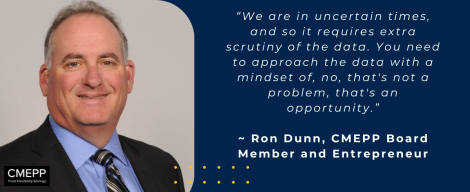
I know that’s really difficult for a hospital administrator. In general, I think we are in uncertain times, and so it requires extra scrutiny of the data. But there’s a huge amount of opportunity. You need to approach the data with a mindset of, no, that’s not a problem, that’s an opportunity. That’s the advice I give to businesses trying to navigate through the maze.
What are some words of advice that you’d give to someone just starting in their career?
My advice to the young people who take my software technology in healthcare course is get in on the ground floor and learn everything you can about what you’re doing and what you want to know. What’s really important is they are needed. We have a huge human resource issue in healthcare and in healthcare technology. There’s a golden opportunity for young people, and while it may be challenging to find the right role, the ultimate reward is in the satisfaction you derive from being a part of a system that helps people when they need it most.